
Garage floor concrete in Sioux City IA - a slab that drains and stands up to salt
Cracked, sunken or puddling garage floor? We rebuild the base, pitch it to drain and pour a mix made to take road salt.
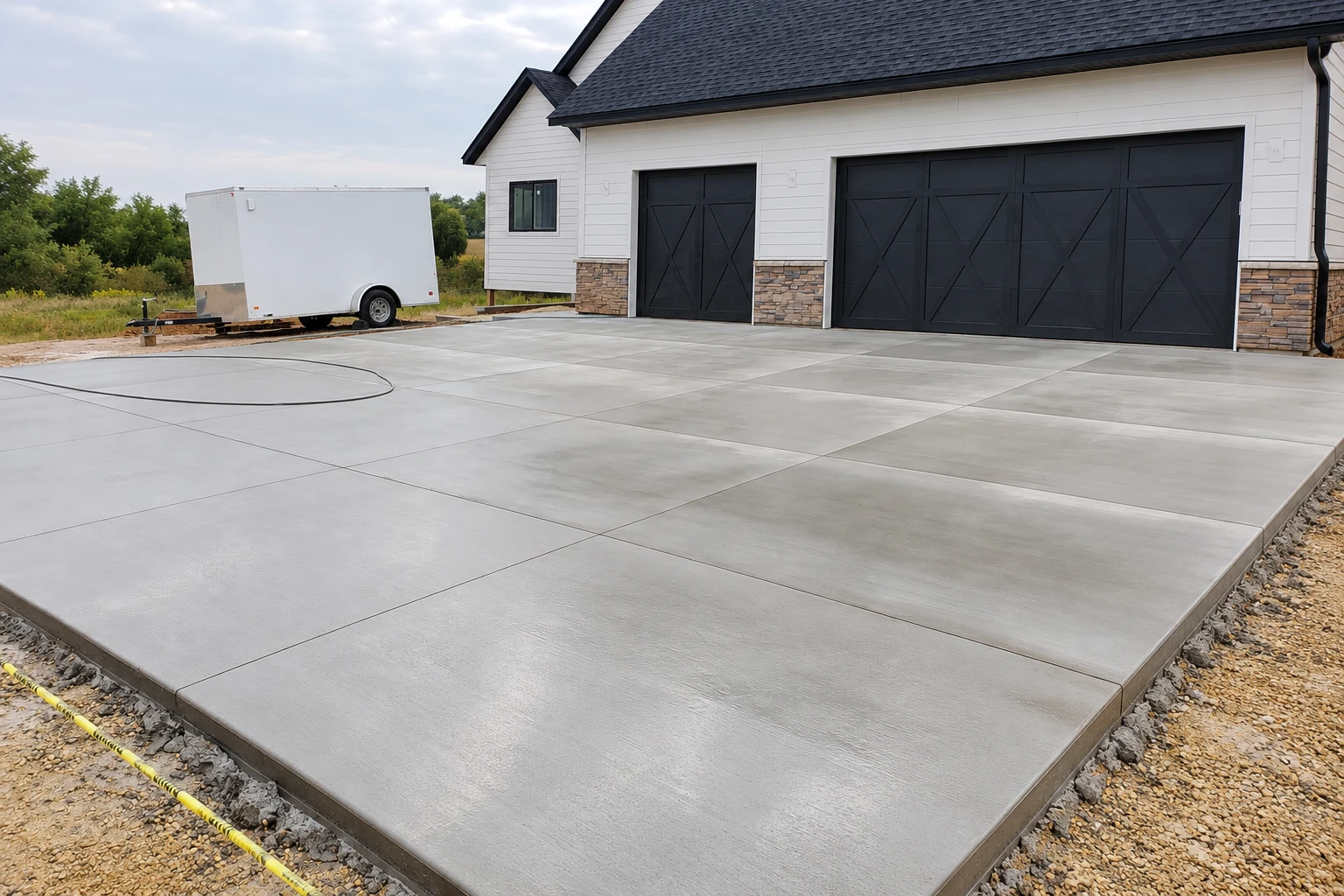
Most garage floor concrete calls we get in Sioux City start with a slab that's cracked, sunk in a corner or holding a puddle under the car. Usually the concrete isn't the real culprit. The ground under it wasn't packed, or nobody checked where the water goes. We fix it from the ground up and pour a mix made for the salt your tires drag in.
Price moves with the garage size, whether an old slab has to come out, how much the base needs and extras like a drain. The schedule turns on weather, any permit and curing, the wait while fresh concrete hardens before you park on it. Your written estimate puts a figure on your floor.
What our garage floor concrete work includes
- A dug and packed base. We dig and pack the subgrade, the ground the slab sits on, since a thicker slab won't save you from soft dirt. Tight budget? Trim the finish, not the base.
- Pitched toward the door. We pitch the floor toward the overhead door, or toward a floor drain if you have or want one, so meltwater runs out instead of parking under your car.
- A mix that takes salt. Your car drags salt in all winter, so we pour air-entrained concrete, a mix with tiny air bubbles that give freezing water room to expand instead of flaking the surface.
- I'm there when we pour. I come out to look at the job myself, and I'm on site running the crew when we pour. We've been in business since 2021.
- Licensed and insured for every job. We're fully licensed and insured. Ask any contractor for proof before they set forms in your garage, us included.
What goes wrong with garage floors
| Problem | What it looks like | Usual fix |
|---|---|---|
| Sunken or settled slab | What it looks like: A corner or the middle has dropped and cracked across. | Usual fix: Break out, dig out and pack the base, then repour. |
| Water that won't leave | What it looks like: Puddles under the car for days, rust on shelves and tools. | Usual fix: Repour pitched toward the door or a floor drain. |
| Flaking, pitted surface | What it looks like: Top layer peeling off in patches, worst where the car parks. | Usual fix: Resurface if the slab is sound, repour with air-entrained mix if not. |
| Cracks everywhere | What it looks like: Cracks wandering across the floor with no grooves cut anywhere. | Usual fix: New slab with control joints, grooves that guide the cracks. |
Patch, resurface or start over
- Patch and seal. Suits a floor that's flat and drains fine but has a few thin cracks or a chipped edge. I'd rather tell you that than sell you a new slab.
- Resurface the top. Fits a slab that's solid and sloped right but has a flaky, dusty or pitted top. It won't fix a floor that's sinking, so I check that first.
- Tear out and repour. The fix when the slab has sunk, holds water or is cracked through, since the trouble is the base or the slope. Want color or a pattern? Ask about decorative concrete then.
How we plan and pour your floor
- You reach out. Call (712) 202-0664 or send a message through the form, and we'll get back to you to set a time to look.
- I measure and write it up. I come out, look at the floor and where the water goes, listen to what you want and leave you a written estimate.
- Permit, prep and pour. If you go ahead, we take care of the permit side, then break out any old slab, prep the ground, pour and finish.
- Walk-through and clean-up. We clean up, then I walk the floor with you, tell you when it's ready to park on and which ice melts to keep off it.
Looking after your new garage floor
New concrete has its hardest season first. The usual guidance is to keep deicers off it the first winter and use them lightly after, and to hose off the salt your car leaves when the weather allows. If you plan to coat the floor, say so at the estimate, since moisture rising through a slab can make some coatings peel.
We're based in Sioux City and pour garage floors for homeowners here and across the cities around it, including South Sioux City and Sergeant Bluff, with some small businesses and builders mixed in. Every job is backed by our satisfaction guarantee. Call (712) 202-0664 or use our form to ask for an estimate.
Tell us about your garage floor
Send the garage size, any drain or coating plans and when you'd like it poured. We'll reply within one business day to set a time for me to come measure.
(712) 202-0664- Free on-site estimate
- Written up after I measure
- No pressure, no obligation
Garage floor questions we hear
Why does a garage floor need a slope?
It needs a slope so water and snowmelt run out instead of sitting on the floor. A flat or badly sloped floor holds water that rusts metal stored on it, makes a slip hazard and can freeze. If water's also running in from a slope beside the garage, a concrete retaining wall may be part of the fix.
Where do I apply for a building permit in Sioux City?
At the city's Inspections and Permit Services, which takes building permit applications and lets you and your contractor schedule inspections and check results. The city investigates work done without permits, so ask that office whether your floor needs one. We check with them, pull any permit the job needs and book the inspections ourselves.
Can you pour a garage floor in Sioux City in cold weather?
Yes, with planning. One concrete trade site says pouring gets risky when temperatures fall below 40°F within the first 24 hours after placement, and that's when cold-weather practices should start. Ask any crew which practices they'll use, and I'll go over ours when I write up your estimate.
Which deicers will damage a new concrete garage floor?
Ammonium sulfate, ammonium nitrate and magnesium-based salts destroy concrete surfaces, so check the bag before you buy ice melt. Your car can also track magnesium road salt in on its own, which is why the rinsing and the salt-ready mix matter.
Does a concrete contractor have to be registered in Iowa?
Yes, anyone earning at least $2,000 a year from construction has to register with the Iowa Department of Inspections, Appeals, and Licensing, called DIAL. Homeowners working only on their own property don't have to. It's a fair question to ask any contractor you're comparing.